Reading while dead

Reading while dead

Sunday, 16 October 2016

Aberfan, the passing on of generations, death and memory

Aberfan brings all these things to mind.  50 years ago I sat up in a double bed with my grandmother and brother Tom, watching the Nine o'clock news on our black and white portable telly.  We saw images of a school building, covered with black slag, and children being dug out and - occasionally - carried away, led away (few of those) crying.

My grandmother grew up in a Welsh mining town - Abertillery - which had, I believe, 6 collieries.  Mining disasters were not uncommon during her youth.  The 6 Bells Colliery had one of the most famous ones, and that colliery was in Abertillery, although it didn't happen until 1960, years after she left the valley.   However, I already knew about mining disasters - I'd seen "How Green was my Valley" on telly, with Grandma, probably, at least twice and I seem to remember there was a mining disaster in that film.  So I already "knew" about these events and the emotions that they evoked in my grandmother, a sort of pride, knowledge, belonging as well as the normal sentimental feelings.

It was a strange relationship, I was very close to my grandmother, she was foul-tempered, narrow minded and very annoying.  She was also an extremely loving woman whose love offerings were frequently misunderstood and rejected.  She tried to please people and be kind - and was frequently given short shrift.  I did not realise her good qualities until she died, when I suddenly recognised them in a moment of epiphany.

The memory of that evening is very clear, as it was the night before we moved out of London, into our new house, the 16thC haunted house on the edge of Slough.  After that evening I don't think we thought much more about Aberfan, I was only 9, I didn't yet read the papers.  There were reports of the deaths, the funerals, the miraculous escapes but those faded against the excitement of the new larger house, and the enormous garden, full of trees, the stream, the fields.

I only realised how this feature of history - mining disasters - was closely linked to my life, while to Mark there were simply "facts".   And of course I realised that mining disasters meant nothing to my children, they have barely been to Wales (except en route to the Irish ferry) and the mines all closed before they were born.   They have seen the old mines around here, what's left of them.  We've been for walks on the shaley park at Fowlmead.

And this made me reflect on the sadness of family history - once I die, all connection of memory with that life in the valleys will be gone.  My mother never cared much about it, and I know so little about it.  I don't know exactly where they lived in Abertillery (I thought Bridge Street sounded familiar) and I don't know which colliery they worked in, although the name "Rose Heyworth" sounded familiar (although that could just as well have been a girl they were at school with).  By "they" I mean my grandmother and Aunt Eileen, and perhaps Jimmy and Joe too.  The older children were already at work, either in the mines or in service.

These are melancholy reflections, and they are eternal - each generation cannot pass down the memories to their children, otherwise our brains would be too packed with precedent to create anything new.  When we went to Abertillery last year (my first visit) all the collieries had gone.
The Rose Heyworth Colliery, Abertillery - in 1985, just before closure


There are signs, and memorials, to mark the sites, but no buildings there.   The man I spoke to pointed out an abandoned leisure centre, that had been built on top of a colliery.  It was so long ago that the leisure centre too was defunct.  It seemed a symbol. The bright plastic system built leisure centres of Thatcher's time (for the redundant miners to spend their free time in ) were now gone too, unloved.   The fine buildings of some collieries still stand - a beautiful redbrick miners' welfare building had become a health centre and nursery in another village; the beautiful Edwardian shops were also still there.

In September, when we went to Cardiff, I was surprised to see a painting in the National Museum, I immediately recognised it as Abertillery - I don't know how, but before I saw the label.  Something about the contours of the valley must have been distinctive and memorable.   I took a photo of it.  The colours are much less yellow - and I was surprised by the fact that it was Lowry.  I didn't know that he left Salford much!   Abertillery is an interesting choice.


Saturday, 15 October 2016

Bloody gardening

The day started beautifully sunny and I decided it was high time to get on with the autumn pruning campaign.  The fig tree is being cut back to grow against the wall, rather than to fill the front garden.   Then there was the sad case of the sambucus niger in the back garden.  Only 3 months ago someone was admiring its lacy foliage and colour and now it's dead.   First all the leaves on the top half of the tree withered and droopped without dropping, a week or so later the lower half of the tree followed.   I snipped a few bits, but it had lost the green appearance and was clearly not planning a revival.   The ordinary elder tree in my neighbour's garden did this two years ago, although his other elder is thriving, still has all its leaves which are slowly yellowing, so in comparison with that, ours was a goner.

There's a lot of folklore about elders and their relationship to witches.  I should apparently have asked its permission to cut it up.   But as it was dead this was a bit difficult.   After I'd been chopping off branches for a bit I went for a change of scene and snipped away at the clematis tangutica with the secateurs, until one handle fell off - apparently due to metal fatigue!  It was sliced right away from the blade.   After coffee I was back on the elder, chopping the branches into smaller lengths for kindling and so on... I nearly put my eye out with one twig, when the branch twirled in my hands and the cluster of twigs at the top turned and bashed my eye (I closed it in time).  Then I kept getting pinched by the twigs in various ways, so once I'd disposed of it all, I decided to make a start on the plants surrounding the elder, which would have to come out before we could remove it.   These were lightly rooted iris foetidissima but they were rather densely packed between paving stones and an old holly root.   I took a fork to the edge of the clump to losen it, and found it unshiftable - I place the fork elsewhere - and felt some movement, so I leaned further on the fork and the shaft promptly snapped.   I nearly toppled into the flowerbed,.  When I removed the fork, I noticed it had bent one of the tines.   I bought this fork for £14.50 about 2 or 3 months ago, to replace a very good fork that broke after about 20 years.  Sigh.  

I do not intend to suggest that I should have asked the elder tree's permission first, but a series of set backs like that could make you wonder.  The unpleasant smell of the elder doesn't help.  

Thursday, 6 October 2016

Bernard the cat

This is a short piece I wrote in the summer, while I was sitting in the garden "working"

Bernard the cat is looking at the mangled frog beneath his paw in a contemplative way.  If he grips it in his mouth again, will it struggle to move and give him some more play?  He tosses it away, then pounces, scoops it up with one paw and volleys it - then leaps on its corpse, tussling dramatically with it, even though it can no longer resist and its short life has ended, here on the lawn, only a few yards from where it was noisily fertilised into life a bare three months ago.


See Naples and Live

I had a slight anxiety about going to Naples, which was quite unnecessary as it happens, since it was much nicer than I remember it.  Thinking about that first trip in 1978, I don't remember one single distinguished meal there, except the pizza we ate in pizzeria that was little more than a cave, rough walled, with a couple of formica topped tables and a pizza oven in a corner.   There was rough wine and paper napkins and those were the only distinguishing features.  There were about 3 types of pizza available.  It was OK.

On this trip we only ate pizza once.  This is because of my desire not to eat flour products (I did try, but not hard enough, and it doesn't seem to have made any difference to my foot health).  The pizza we had was dire, served luke warm, I had a seafood topping which was basically a nice pile of sea food mix, on top of what was essentially passata soaked dough.  Mark had something more elaborate but it was lukewarm and soggy, not in a good way.  However, overall, our experience of food on the trip was not much better.   I will make a longer blog about that subsequently.

What is great about Naples is that the people are incredibly helpful, and fairly charming - although the waiters keep asking you how the food is, which is awkward when all you want to say is "Average".   The sights of Naples are astonishing because many of the most beautiful things are hardly mentioned, such as the 4/5th C baptistery in Santa Restituta, part of the Cathedral.  We didn't go to Pompeii, but we did visit Herculaneum - where things were sadly decayed.  Wall paintings and mosaics are largely unprotected.  RSJs have been introduced periodically to prop things up.  There is a good deal of scaffolding.

As a whole Naples itself does not have any stand out iconic buildings or works of art, however, it has an incredible wealthy of very good buildings and works of art.  So while there are no "must see" destinations there is something wherever you look.
I can't remember what this building was, but it was at the bottom of the Via Toledo I think - and there is architecture like this everywhere, despite frequent earthquakes and terrible bombardment in WW2 by us, the US and the Germans.

The real joy of Naples is wandering the streets and dropping into things as you wish.  Being able to go to the famous Caffe on the Pzza Trento e Trieste and just sit and stare is great.  And of course there are the endless glimpses of the bay and of Vesuvius - so although not "every prospect pleases" a great many do.

Parts of Naples have been cleaned up a lot since I was last there, and there are places like the Spaccanapoli which were formerly a bit threatening, have now basically become tourist thoroughfares.  It's not clear how many people stay in Naples for any length of time.  Judging by the BA passengers most of them went to Sorrento and did day trips in, escorted in groups by umbrella-brandishing guides who shwoosh them through Santa Chiara and out again.  The Duomo seemed to be the biggest draw, but the beautiful Baptistery was almost empty.

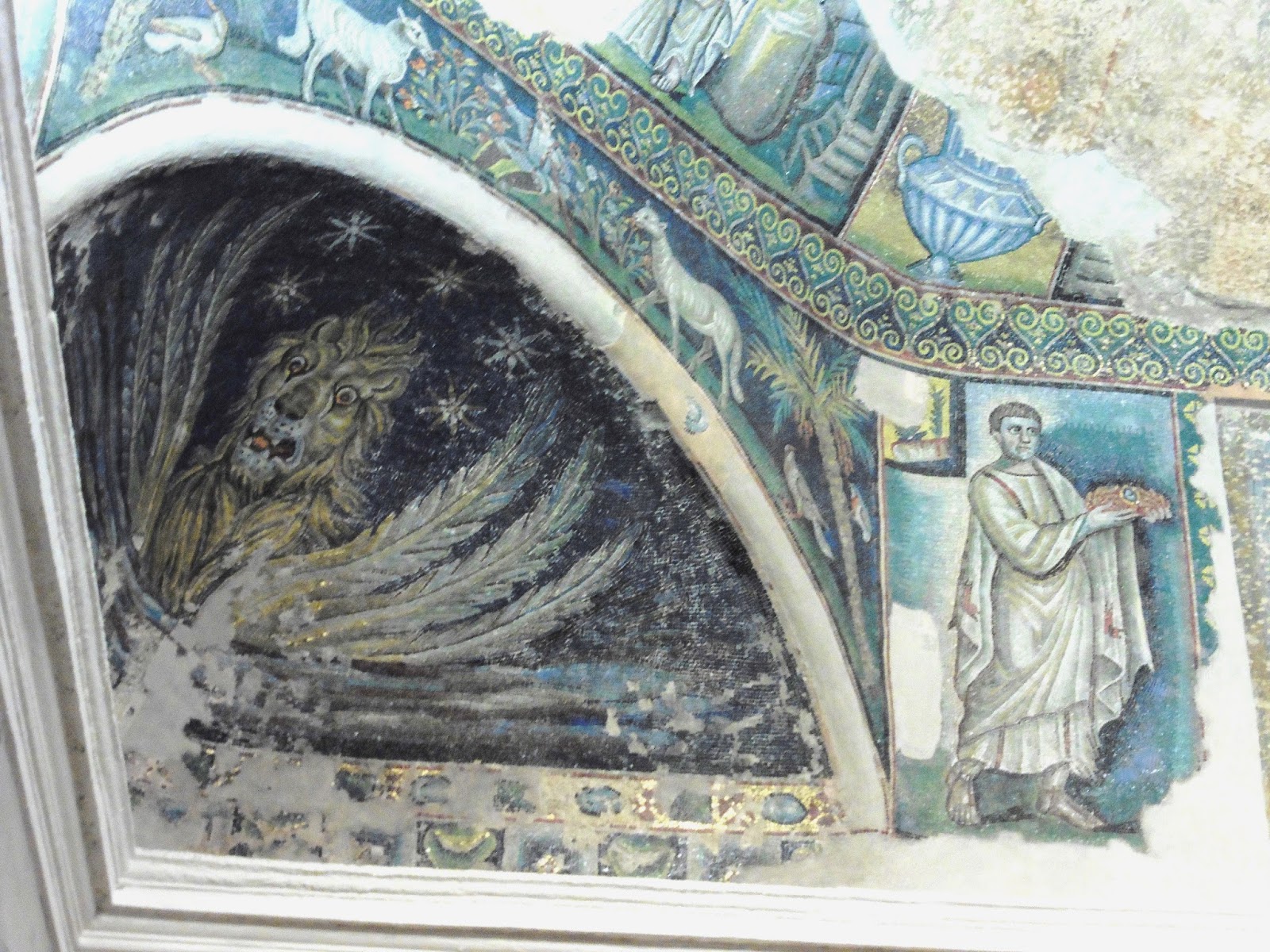
This picture has been doctored a bit, it was quite dim in there.  Each of these corner apses has a symbol of the Evangelists.   Remarkable how architecture and significant groups seem to fit.  Suppose there had been 5 evangelists?  How would that have worked?

I would love to go to Naples again, and see the things I missed, and find better places to eat, or at least have lower expectations this time!


Monday, 12 September 2016

Reading for the Holiday!

I seem to have read about one book for every day we are going to Naples, as a way of preparing myself and returning to  more Italian mindset...

A view of Vesuvias, across Naples


I read Norman Lewis's "Naples 44" which I enjoyed very much at first, until the sheer fuckwittedness of the military miindset and the British and US behaviour in connexion with the Neapolitans, began to depress me.   The description of the Vesusvius eruption was interesting, not one of the more drastic ones, mercifully.   Accounts of how people were starving unaccountably surprised me.  I don't know why.  Obviously they wouldn't have anything to eat.  It must have been a while before food supplies returned (they do during the course of the book).  I wish i knew more, about how people recovered after the war.   I don't suppose those much lauded Elsa Ferrante books tell you that, otherwise they might be worth reading (yes, I know, everyone's reading them, says they are brilliant etc).

Then I began to read "Gomorrah", the journalism on which the film was based.  It was depressing, and would probably make me think it wasn't worth going there, or even frightened to go there.  It's ludicrous, I haven't been to Italy for 8 years, in my 20s I went virtually every year.  I didn't realise I hadn't been to Naples since 1978!  It was a bit of a hustle, but we coped.  I am sure that it is now a bit less ground down and impoverished, and that I am more savvy, so there really shouldn't be a hustle.  And no one has ever tried to steal my handbag from a Vespa.

I bought a book called Joanna, Queen of Naples on the Internet.  It is excellent, but I haven't got very far with it.   The medieval history of Naples is tricky, a lot of discontinuity.  I believe it was part of the Holy Roman Empire for a while (possibly Frederick II hung out there?)  Then there were the Angevins, Charles of Anjou et al (how did they get hold of it?)   Then the Aragonese had it (they couldn't get hold of any more Spain - so they conquered it?  Or was it inherited in some way?).  Eventually it became a Bourbon kingom, the Kingdom of the 2 Sicilies, which is the era I am more familiar with.   Perhaps once I've read the Joannna book I'll be more au fait with the situation.

I also bought a short novel by Alexandre Dumas about Queen Joanna - which I have not yet started.

Then there was Route AD66 - an interesting book about tourism in the Roman Empire.  That was very interesting, but I decided to stop reading it after it left Athens.   The book retraces Tony Peroettet's tour around the favourite Roman tourist itinerary with his girlfriend and intersperses nuggets of information gleaned from classical writers.  A lot of this is familiar stuff, but quite enjoyable, not sure how reliable a lot of it is.   I was a bit mystified by the author, although he presents us with a lot of erudition, he says some remarkable things about the Roman's cotton tunics - the Romans had cotton, imported from India and China, but it was hardly an every day fabric, although I suppose those rich enough to take the Grand Tour could probably afford it.  He also described someone choking on polenta in a Greek inn - unlikely given that maize didn't arrive until the 16th C, there were a couple of other questionable references, which made me think that perhaps he was not exactly steeped in the Classical world, but had simply done a hack job on the source materials.   Still, it was amusing enough.

Tim Parks "Italian Rails" is not strictly about Naples, but it was an excellent way to remind me of the Italian mindset and the important words furbo (cunning) and pignolo (a jobs worth).  It wasn't as funny as some of his other books, but very recognisable.   His conversations on trains, and attempts to avoid them are very true to life.

The first book in this set that I read was Bepe Sevignini's "La Bella Figura" which was a very kindly view of Italians.  It explained them in a better way, and made me understand that perhaps they really were better, more Christian people than, say, Brits.,  It was a good way to read about them, from the inside, rather than the outsider view (however well established Parks is he still knows he's an outsider).

Oh, that's only 7 books, I expect I can count the Lonely Planet Guide, the Eyewitness Guide and other materials, to say nothing of all the websites.

Monday, 5 September 2016

Jeremy Corbyn - in the flesh! And in the garden!


Here is the East Cliff at Ramsgate, the area around the bandstand, opposite Wellington Crescent, where Jeremy Corbyn spoke on Saturday 3rd September.  I had long standing other commitments to cooking that day, but I had to leave the house to take N to A&E and decided to make a detour on the way back to see if I could see anything.  I was thrilled as I dawdled along Wellington Crescent, to see so many people there.  It made me feel rather emotional to think that so many local people had come to hear him.   He was actually speaking as I passed, so I heard a few positive sounding phrases.   I was sorry I hadn't been able to be part of the fun.  I was amused to hear later that UKIP had insisted that there were only 1000 and they had all been bussed in by trade unions.  Even the BBC had said that there were 3,000 people there.  No sign of the coaches could be found.   It contrasts famously with Nasty Nigel's "mass rally" at Cliftonville in 2015.  He spoke from the UKIP battle bus - Jez spoke from the back of a fire engine.   UKIP claimed 300 were present at NN's rally, but a careful count of the audience photo showed approx 79 people.     However, that's enough sectarian nonsense.

Later I was at the BBQ, an LP fundraiser, and someone said "Jeremy Corbyn's here!" and he was, in the kitchen.  So I retreated to the garden, and soon he came out to join us, and we and some others began a chat about gardens and allotments.  I can now reveal the following fab facts.
He has a 30 ft garden which is mostly paved because the soil is largely builders' rubble, however he grows vintes and olive trees, because they thrive on lime.  At his allotment he has grown a lot of beans and spinach which he freezes.  It is difficult to grow some things, because they need daily watering.  He has problems when he goes to the AGM because they always want to vote him onto the Allotment Committee.  Mark told him about our old allotment, and Jane H's niece commented that she goes running up there.  He told us that allotments couldn't be developed by councils if there was demand for them, so clearly we need to create demand to stop local ones disappearing.  Someone said Ramsgate houses had huge gardens, but I said that a lot didn't because they were built as holiday lodgings.  Someone else said that gardens were often full of buildings, and the conversation shifted and Jane H wisely nabbed him to talk to him seriously about mental health...

So, there we have Jeremy Corbyn, a nice beardie man, standing in a summer garden chatting about growing veg.  I didn't even dream of trying to talk politics with him.  Is he ready to lead the country?  Why not?  I swear we've had worse people.   Intellectually/socially he's probably roughly equivalent to David Cameron, able to mix affably with people and have normal conversations, although rather lacking in DC's PR skills.  I also noticed that in conversation he didn't try and draw other people out, this is fairly typical of men in general, so I won't hold it against him too much.    He does have courage and integrity and these are rather more important in a leader.,  I doubt whether Churchill was much of a one to draw out people in conversation either, it's not an essential skill, although I suspect it would help if one was trying to get to know one's Shadow Cabinet better.


The Book Group read #1

I have been in a Book Group for 12 years yet I don't think I have ever blogged about it.  There are about 4 of us who have been in it almost since the beginning (I was not there at the beginning).  We have lost members to bad eyesight, boredom with the books, boredom with one of the other members incessant chat, a refusal to read the books.  Occasionally people have turned up once and never come again, and we had a flounce out of a long-term member.

We have a policy of reading intelligent books that take us out of our comfort zone (actually, I am very seldom taken out of my comfort zone, but I usually enjoy the books).  We have a policy of having no easy books. We occasionally read non-fiction, but most of our choices on the whole are pretty safe and reliable.   If I find them challenging it's sure as dammit the rest of the group will hate them.   There are several former teachers in the group, a retired librarian, retired social worker, a former radiographer and my friend J who worked in the media.  I am the youngest by about 7 years I think. The oldest is 93.  We are all women (the founder and sole male, Barry) moved back to Lewes 11 years ago!

July/August 2016 Book

River of Smoke by Amitahv Ghosh


We read Sea of Poppies in 2010, but no one could remember it, except me, because I absolutely loved it and thought it was brilliant and wished to write something that clever but knew that I couldn't.   Recently the third book in the trilogy came out, and I suddenly realised we hadn't read the second one yet.

It is a long book and it is, like its predecessor written from several points of view.  The main character is an opium smuggler called Barry Mohdi - it is set chiefly in 1830s Canton and the main characters are Parsee, Muslim, English, French, Chinese etc.   Canton was clearly a fantastic place.  The story tells of the events surrounding a clampdown on Opium sales in China and the characters are becalmed in Canton, trying to sell their illicit cargoes.  There is also a search for an illusory form of paeony (or was it azalea?).  So many different strands, and the whole society is brought alive.   Characters such as Neel are carried over from the previous book, but I had forgotten about him until halfway through.

Modhi is a deeply sympathetic character, rather like Robert Maxwell.  The book is curiously relevant, because it echoes the present economic times, with merchants who are illiberally fixated on Free Trade at all costs, regardless of what this will do to the economy.  The British sold the Chinese opium, because they had no other commodities the Chinese wished to buy.  They did not wish to have a one-sided trade where they bought tea and silks and porcelain, and all their money went into China in return for perishable goods.   Just like the Roman Empire, and just like now.  The modern obsession with Free Trade in a globalised market place went echoing through the book.

My favourite aspect of the book were the camp and clever letters written by the young artist Chinnery to his friend "my fair Puggelina".  Ghosht manages to transform her nickname into every imaginable silly camp foreign title and never repeat himself once.  It was a delight, and it lightened the tone of what would have been some very depressing events that could have turned the whole book into a gloom-fest.  Clever!

The other glory of the book was the fact that one was getting "history lite" in the most stimulating possible way.  I understand far more about that period and the run up to the Opium Wars than I ever have before.  A five star read if ever there was one.