Reading while dead

Reading while dead

Monday, 6 March 2017

Harry 12th January 1990 - 27th February 2017

Arrrghhhhh.   This is such a terrible story.   Harry was my brother Tom's son; his parents split when he was 7, my brother's input after that was minimal.  His mother Heather is a materialistic nitwit, obsessed with appearances, she always preferred his younger sister Suzy and as a result of this, and her very limited nuturing skills, Harry was a very neglected child.  He left home at 18 and never had any higher education.   He started taking drugs quite early and his mother's family blame all his problems on that.  They prefer not to ask why a child would want to seek comfort and relief in drugs.   He was not an addict, he took them when he needed comfort or when he wanted to, for fun.

For several years he tried to get going as a music producer/creator but it was hard work and he was often sofa-surfing and didn't really have a proper base.   He made a great friend called Leroy and together they went back to Leroy's native Bradford and Harry got into various bits of sales work, etc. up there.    In summer 2015 he and Leroy had an argument,  Leroy threw himself out of a second floor window and died immediately.    The police responded by tasering Harry and arresting him for his murder (although he wasn't actually there at the time).  For 6 months he was a suspect, and Leroy's family and friends blamed him and basically ran him out of Bradford.   He went home to his mother. This wasn't very convenient, as, having just divorced her second husband, she was starting a relationship with a wealthy medical consultant, approaching retirement age (she is 52) who was clearly shopping for a future nurse.  He has a house in Italy, took her to Barbados, bought her a fur coat etc etc.   While Heather is swanking around the place, Harry is doing another grim telelsales job and taking anti-depressants and not getting proper treatment for the trauma of losing his best friend, of seeing his mutilated body outside their flat, and of being under suspicion of murder.  Heather starts to demand more council tax money off him and Harry sees the fur coat, the Jag and the holidays and he flips.  One night, when he's working on his motorbike in the garage he takes his clawhammer to her car and then he goes in and burns one/all? of her fur coats.   (He swore to me that he had not been taking drugs prior to this, apart from the anti-depressants).   He goes upstairs with all the kitchen knives and nails his door shut, intending to kill himself.    

When his mother came home she called the police who went upstairs and tasered him and took him into custody.   His mother then did what all mothers would naturally do, she took out an injunction against him which prevented him contacting her except via solicitors, or coming within 50m of his home.  Harry went to prison on remand.
Harry whizzes past on the dodgems - right
Where we come into it, is that I wrote to Harry in prison, expressing sympathy, but he didn't get the letter.  I assumed wrongly, that some member of the family, Tom perhaps, would be in court to hear his case (I had no idea when it was and that weekend I discovered that Ned was having an anxiety crisis and we needed to go to Norwich in a hurry).  About a fortnight later I got an email from my youngest sister begging us (my siblings and I) to try and speak to Tom and to persuade him to take on his paternal role and give Harry a home as he was currently living rough and had been seen begging outside Tesco's in Southampton...He had been found guilty of criminal damage with an 18 month suspended sentence and set free, on probation, with nowhere to go except the streets. 

I didn't think Tom would provide a particularly loving or supportive home for Harry, so I called his other grandparents and found out where he was and went to get him.  That was in July and he's lived here ever since.   He was absolutely charming although with a tendency to tell fibs, a necessity from childhood I suspect, like his habit of hiding broken crockery.  He wanted to get himself sorted out, but was frequently depressed.  He got a job almost immediately and seemed all set, but it was a sales job and he didn't make his targets during his probationary period so he was sacked.   He then began to look for more manual work, and was hoping to go on a Railtrack training course.  In the meantime he was in his room, watching endless films and making more music, trying to perfect a particular piece that he'd been working on since he came here.  Finn spent a lot of time chatting with him, and we all had supper together in the evenings and had a chance to talk.  I realised quite early on that although we could provide a fixed address and stability for him there wasn't much we could do about his state of mind, but he told his other grandparents how he wished he'd been brought up in our family and how I was a much better mother than his ("Of course, he didn't mean that" she told me).  I did try to nudge him towards drug counselling and so on, but when he first came, I don't think he was doing drugs at that time and while he was working, only on "party" basis, rather than habitually.  I suspected his drug use had increased a bit in January, he began to keep strange hours and would have intensive bouts of hoovering in the middle of the night. He went to one session with a local drug counsellor (who is a friend of mine) but didn't continue.  He was doing bereavement counselling to cope with Leroy's death, but a couple of days before he died he was wondering whether it was worth continuing, he wasn't sure if he had anything more to say.  Actually, he probably needed about 10 years of therapy to say all he needed to say, and I was hoping to win the lottery so I could pay for it. 

On Sunday I was admitted to hospital with a rather awful infection in my abdomen, related to gall stones.   On Monday Mark rang me and said he was coming in to see me and I said "Just go and have a chat with Harry and see how it all went on Sunday" (he had met up with his sister, Tom, my father and my sister C - a very rare event which had been brokered by C as part of her campaign to get Tom to behave like a father).    Mark went up and found Harry lying naked on his bed with his laptop on his chest, he called Finn, Finn's friends rang 999, M and F tried to find a pulse, without success.   The paramedics arrived, but clearly Harry had been dead for about an hour before they arrived.  There's been a post-mortem, we don't have the results yet; my suspicion is that his early use of cocaine, crack and heroine when he was younger, coupled with a phase of anorexia where he took drugs instead of eating, may have weakened his heart.  

Last week felt like the longest week of my life, and his, presumably guilt-stricken, mother immediately took charge as next of kin and has arranged the funeral and so on and not told us anything (apart from giving Mark a self-justifying spiel about "if you had seen the damage he did to my house and car").  I am extremely angry with her,  Finn has been absolutely traumatised by it and is distraught and Mark is feeling very shaken.  I want to ring her up and scream at her "My husband and son tried to revive his lifeless corpse, and now you are pretending it's nothing to do with us."

There are so many other poignant details I could add, but this is quite enough really.  I should say, when we took him in, I hardly knew him, I used to see him at Christmas, and at the summer birthday do, so it really was great to have had the opportunity to get to know him better, even though it has greatly added to the sense of loss we all feel.
Harry, Ned and Finn at Dreamland summer 2016


Tuesday, 21 February 2017

Book of the Day: The Loney - Hurley

I had wanted to read this book a lot, because it deals with issues like belief and so on (a popular topic currently) and was given a copy for my birthday.   It is book of the day, because I am enjoying "bedrest " just now, so I am getting through a fair few contemporary books.  I expect my rate will be slowed when I get onto C. Bronte's Shirley - our current Book Group read.

I enjoyed The Loney enormously, I liked the description of the countryside, could see it etc, and really enjoyed the characters and the evocation of different styles of Catholicism in the 70s.  What I found a little odd was the way it was described as "horror".   It is a darkish novel, and it contains some unexplained, supernatural elements, but horror?  I didn't find it scary particularly, I was intrigued as to what would happen.  We know from the beginning that the main character, the presumably autistic, mute Hanny, is cured somehow, but it is never made clear how or why.  

The book employs two particular horror genre memes - firstly the unfriendly natives, and secondly, the ominous objects (two separate ones) and a tense scene in which the unfriendly natives enter the rented house.   So far so Wicker Man/Straw Dogs etc.  But then there are three inexplicable people who are also apparently strangers - who are intertwined into the story. The narrator has no religious faith and doesn't seem fazed by anything, because he's a boy and it's all an adventure, so he doesn't have any sense of horror. Any horror must be in the reader's own mind, expectations based on readings of previous horror stories.   As I don't read this genre (except in classic forms, such as Stoker and M R James) I probably don't get so readily triggered by these cues.

The characters are very good, but because they are all described from the boy's point of view we get their actions and conversations, and the only way we get any sense of their inner lives is when he eavesdrops.  As a result, this makes them feel as though they are operating the plot - and it occurs to me that this a problem for all genre writers (to some extent I have found this) because the plotting is very important it is essential to get it properly functioning. However, they are realistic characters, and perform well in an ensemble.

Whose story this is is another question.   The narrator does go through a great change, but that happens after the main events of the book have occurred, and it cannot be quite understood.  Indeed, what happens at the end is remarkably difficult to understand, and the joy of the paranormal is that is doesn't require a rational explanation, simply a suspension of disbelief.   However, the excellence of the book, in creating a credible ensemble of characters (despite certain clunkiness alluded to above) means that it is harder to suspend disbelief when the final events occur.  And they are not explained.   Well of course, only a very simplistic literal person like me would expect to understand the ending!  For heavens sake, this is where the reader has to do the work, provide the narrative, probe their worst fears etc.

If the story is not the narrator's then it is his brother's, but we do not see his mind, only his brother's view of him, indeed, this is why the characters are so "operational" because we are only see them from the narrator's 15 or 16 year old point of view, and he is only interested in certain things about them, we do not know the rest.  His mother is astonishingly 2D though, but then again, I doubt whether either of my sons at that age would have formed anything like a nuanced view of their mother.  She is transformed at the end, in his eyes, but oh, I don't know.  She is transformed from 2D priopriety and piety to 2D happiness, so it's not something heartfelt.

There is a sort of pathos in the description of the "shrine" and the damage to the church, which does add to a doomy sense.  On some level you may expect this anti-Christian (or simply anti-Catholic) activity to be diabolical, but it doesn't go that far.  It fails to be melodramatic, and that's a good controlled thing, but I still want to know: WTF happened?  How TF did he get cured?   In this unresolved mystery I am reminded of similar annoyance with Waters' The Little Stranger and Jessie Burton's The Miniaturist.   I love a supernatural element in a book - but it needs to be explained, rather than sketchily hinted at, or shown and withdrawn.   And I could start on the apples.... but that's another thing.


Sunday, 19 February 2017

Sick Diaries 5 Alternative Remedies

My sister in law recommended an alternative remedy, which involves drinking a lot of apple juice "to soften" the gallstones.  Presumably this makes them less painful when they are bashing about, the "cure" continues with you taking a lot of epsom salts and so on and lying very still while you pass them, and eventually deposit them in the lavatory.   I query whether even these softened stones would pass painlessly.  Besides, after you have done this, they recommend you have a colonic irrigation, so I may have to give that one a miss.   Subsequently I have heard of one person who performed this operation successfully.     However, I began to drink apple juice and then I stopped.  By coincidence the period when I stopped drinking it was when I began to feel better, so I now wonder, having resumed the apple juice, whether it is actually churning them up somehow.     I don't even know how this would work.  Presumably it's malic acid that softens them, but how does the malic acid get into the gall bladder?  Is it filtered out through the liver.   Or what?   I may stop taking the apple juice and see if it feels any better.

My nephew Harry said "Milk Thistle" was the thing to help liver function, so we have bought a box at vast expense.  I don't even know how I'd notice a difference but perhaps if I have a less tender liver and fewer pains in the liver areas I might feel better about it.   The only negative side is that it promotes oestrogen production, so not very good for fibroids, and I've only just about got over the whole unexpected bleeding etc.

Another suggestion, fairly harmless I think, is that I could have Epsom Salts baths - and this apparently draws out impurities - which is one of those nicely imprecise alternative medical phrases that sounds reasonable and reassuring without being very specific.  Anyway, it can't do any harm I guess.

What else do they suggest?  I dunno, should do more research I suppose.  

Sick Diaries 4

I have to say that I felt much better on Tuesday night after the trip to the specialist, all my nagging fear that it could be something worse had gone.  We ate a fairly normal meal by most standards, although for us it was quite abnormal - a "luxury" ready meal combo for Valentines Day, and I had a glass of some decent white wine.   The next day things weren't too bad.  I taught and went out and about.   However, since Thursday I have felt pretty awful and have gone to bed in the afternoon - or slept for hours in the morning.  I've also been having lucid dreams and the co-codamol doesn't seem to be working much.  Additionally there seem to be increasing pains higher up - under my ribs and in my breasts, and lungs.  This is presumably my swollen liver having a grumble.

So, what to do?  Yesterday I saw my friend S and she suggested various things.  Mainly that I stop trying to DO things, and just take a month off, and try to get myself healthy enough to go on holiday.  It is appealing advice, and we talked about the psychosomatic elements in the disease, and the disappointment and rejection I'd been feeling.  Curiously, I dreamed about being a priest last night - can't remember the context though.  The feelings I have about the lack of interest in TMOF or The Road through the Woods as it's now officially known are similar to the feelings I had about being turned down when I thought I had a vocation, I feel a sense of having been betrayed by my intuition, by God, that my sense I was doing the right thing, trying to exercise my talents to a positive end, had been absolutely futile.

Whether I can get to the bottom of my feelings of rejection and misery is another matter, whether I should even think of carrying on with my efforts is similarly unimaginable.  There is clearly a lot of psychological stuff to deal with...

Tuesday, 14 February 2017

Sick Diaries 3 A visit to the gastroenterologist

Today I finally went to the specialist.  He had an excitingly vowel-free Polish name and I was expecting a 40-something energetic young man with a nice strong accent.   Instead I got an extremely steady and low key man of about my age with a home counties accent who is probably a product of one of our Catholic grammar schools, to which all bright Polish boys went without exception.  Or maybe he went to one of the private schools if his parents were more affluent.  I almost thought I knew him from somewhere.  He was steady and quiet which prevented me making jokes.

Before I went in I was weighed and had my blood pressure taken.  The nurse who did this was far from young, again, about my age.  I suppose it is a product of getting older, you really start to notice people like you, who would once have been retired, now still at the coal-face.   My blood pressure was good 122/72 - much better than last time.   I expect my weight loss has helped.   There was another, younger, blond nurse, everyone was very friendly, and it was terribly quiet.  This part of outpatients is called Area B which sounds nicely science fictional, you enter Area B and there is nothing but a sea of blue seats, with one person sitting at the far end.

The gastroenterologist asked me if I had had developed any new symptoms.  I told him about the chest pains, but forgot to tell him about the shakes and lightheadedness.  He ordered an MRI scan, and more blood tests.   He told me he thought a stone was stuck in the bile duct and that was why it was grumbling all the time, if so, while annoying, it is very reassuring.   If this is correct they will send down a camera and remove the stone, subsequently, if necessary, they will remove the gall bladder.  Joy.   There is some concern about my liver, which is fatty "because you are fat" but is behaving badly probably because it is being affected by the gallstone situation.

I took my blood test form down the passage.  My veins were playing up, and it was touch and go, even with the butterfly on the back of my hand.  Sometimes it has come out so slowly that it has coagulated before the sample pots are filled.  This time there was a new sample pot, with a brown lid, as well as the more familiar purple lid (the other familiar ones are yellow and green).  I vaguely associate brown with the liver - the meat, liver spots etc. liver-spotted dalmatians.  But perhaps it's nothing to do with that.

The sun went in and cloud came over.  We went home.  What next?


Sick Diaries 2 Painkillers

I have never been a great one for pills, but in the last year I have found myself taking four a day, regularly - and occasionally more.  Two of these I've been taking for years, for my high blood pressure - losing two stone hasn't made much difference to that yet.  The other 2 are the high dose of anti-uric acid I am taking for the gout.   Recently my GP tried ant-acids but they didn't make much difference.   I stopped taking them, as ranitidine has some nasty, albeit rare, side effects.   So the other pills I take, occasionally, are pain killers.

I am puritanical about them.  I take ibuprofen for any joint/muscle pain, but I know that taking them regularly is bad, and does increase your chance of having a stroke.  As my mother took them regularly from her 50s on wards and had a stroke aged 72 I tend to avoid them unless the pain is unbearable and prevents me doing things, or wakes me up at night.    

Recently my GP has suggested paracetemol for my pain, coincidentally I heard a medical programme on Radio 4 which said what I had always suspected, that paracetemol doesn't actually work (except for getting temperature down and delighting babies - I can clearly remember the Calpol magic, the first time I gave Ned a spoonful). I've very seldom used paracetemol, as a child we usually had aspirin, until we were told paracetemol was better.  Perhaps it was.   When I had period pain as a young woman there was a magnificent drug called Veganin - which I don't think exists any more, but it was an aspirin and codeine mix.  I realised then that codeine was probably the only really worthwhile easily available painkiller.  This view was confirmed when the Greek government banned its import into Greece: you couldn't take it in your luggage for personal use.

So now I am taking co-codamol, and it works for several hours and I am able to take it in the evening and it helps me sleep without waking in any possible pain.  I am also experiencing bouts of light-headedness and occasional shaking... possibly low blood sugar?  However, I find if the pain is bad in the morning, I take it then too and it helps me get through the day with an illusion of capacity.

Thursday, 9 February 2017

Sick Diaries 1

One of the reasons I haven't been keeping up with the blog much is because I have been sick.    The gynaecological (fibroid) problem petered out with my oestrogen supplies, but I still found that my foot problem, which turned out to be gout, was getting me down.   However, by October, the gout medication was working, I was far less stiff and achey and I had the benefit of a lovely Neapolitan holiday, so I was feeling almost oojah-cum-spiff.   In November two things happened, firstly another attack of gout, and secondly the beginnings of the stomach pains.    These have ebbed and flowed for the last two months, and have been provisionally diagnosed as gallstones, but as a result I have been more or less in pain every day since.

The reason I think things are a bit odd is that the pain is not behaving like gallstones (yes, I do have pains across the back, but there are other symptoms too).  What I have learned is that I can only eat minuscule amounts of anything.  So I can have a perfectly satisfactory lunch of 4 chocolates - giving me all the fat and calories I need to keep going, or an apple, but an apple seems to inflame my stomach (as does apple juice - which I was told was a sovereign remedy for gallstones - it softens them apparently).    Things that seem to agree with my stomach are: cheese, chocolate, cake, biscuits coffee, bread, porridge, milk (this would point towards an ulcer), while fruit doesn't seem to work, apart from bananas.   I am also finding that the long food free afternoon is bad, I get ravenous and then eat too much (in quantity terms, not calories) before supper.  I then spend the evening in pain.   Last night I discovered fish and chips was not terribly good.  Probably ate too much.

Anyway, the crux of this is that I feel considerably lower in energy.  I went down stairs earlier, washed up, hung out the washing and then felt knackered.  In the middle of doing that, I felt great, I felt "better", but bending and stretching played havoc with my stomach and the pain came back.    So all my thoughts that I WOULD manage to do some submissions to agents this afternoon, have turned to mush, and I am not feeling up to it.  I don't know how long this period is going to last, but I am thoroughly fed up with it.

I have been promised a fast track appointment, to look at this, which ought to happen in the next week (as it did not happen this week).  Perhaps that will make some progress.   I imagine they they will whip out my gallbladder within about 6 months, after which, life may return to normal.   In the meantime, I just wish it was possible to live without eating.

Saturday, 28 January 2017

Absorbing a death

My mother died more than 7 years ago now, and it has taken me a long time to make sense of my response to it.

Firstly there was a shock, and a small sob, and then the machine swung into action, I drove up and down and arranged the funeral, the order of service, the catering, the wine etc.  and finally there was the funeral, at which I spoke, and the burial, at which I briefly and finally broke down.  When it was over, I was very tired (there were about 3 weeks between the death and the burial).  There were other things happening in my life too, difficulties in the marriage, the invasion of the LO into my life and so on.  The thing that obsessed me in that period was that I didn't really feel sad, I didn't miss her very much, because the stroke had already removed a lump of her personality.   But after her death, all I ever seemed to recall was the negative things about her, all the worst things she'd ever said and done to me.  I talked to an older friend who had also had a difficult relationship with her mother.  She said the same thing had happened to her, but that after a few years she had found it wore off.  So I waited, occasionally being stung by painful memories, assisted by strange anecdotes about breastfeeding and her fury when she discovered she was pregnant with me.    I remembered how my parents used to say sadly about some friend of theirs "he was rejected in the womb" as if this was the most dreadful thing.   I guessed now that technically, I had experienced this too.  But over the years, occasionally I would read something, and realise that I had much more resilience, because when I was born I was surrounded by people who were delighted and excited to see me and greet me and were just full of love for me.  I was my father's first child, and my grandparents' first grandchild and I was loved and a little (tho not excesssively) spoiled until I lost my unique status 2 years and 4 months later.  Whatever disregard my mother felt, I knew I could find love elsewhere, my grandfather was probably the first choice, I spent more time with him than with anyone.  My grandmother and father worked full time during the week, so I saw less of them, but my grandfather was there every day.

So, this thought has especially consoled me.  Nevertheless, it has still perturbed me how little love and sympathy I have felt for my mother in the years since her death, and I tried to make sense of them.    This evening M and I were discussing one of our former friends, one of the "flouncers" - there are four, no, five people who have flounced off in a rage in the last three years.  One of them has flounced back, but I sense that she doesn't really like me.  Never mind.  She behaves very well.  But when I think of them, and specially of the latest exit, last year, I feel a similar feeling of release.  The feeling is of liberation.  After one has experienced a period of putting up with bad behaviour, and smiling, and pulling one's punches in a relationship, one is liberated to speak one's mind, one is no longer constrained, no longer has to make excuses for them.  One can say what one honestly felt about the person's behaviour without directly attacking them, or poisoning the rest of the relationship.    I remembered how liberating it was to complain about and criticise those erstwhile friends who had to an extent held one in thrall.   One had cast off the chains of a restricting relationship, and after so many years, I realised that this was what had happened when my mother had died, but that the parent child bond is so sacred,. I was not allowed to rejoice in my freedom.   I had not even allowed myself to consider that I was liberated, although, I do remember consciously thinking "now I can get on with my writing" when she first became ill, and it was apparent that she would never really be able to read again."

Wicked, perhaps this seems, but I realise that I did have to put up with quite a lot and it has taken me a long time to work through those feelings.  I hope I get rather more years to enjoy more life than she did after her mother died!

Anyway, in the best facebook tradition, here's a picture of my mother showing me affection when I was about 2 or 3.


Thursday, 26 January 2017

What to do with money

Of course, I occasionally indulge in fantasies about money.   What I would do if I had more, just a bit more, and what I would do if I had an enormous amount more.

I would pay for proper psychotherapy for a couple of people I know.  Finish doing up the house, and get carpets!

One of the things I would enjoy would be the relative freedom to do things I liked.  Ever since our trip to Naples last autumn, I've subscribed to an email called "Naples Weekender" which tells you fun things to do in Naples.  It arrives every Thursday.   This weekend it informs me that Rigoletto, one of my favourite operas, is coming up the Teatro San Carlo for a couple of weeks.    If I were rich, I would book a couple of flights to Naples and go and see a performance, spend another day or two there to do something else, see a museum or a church we missed last time, go to some better places to eat, and then buzz home again.

In the grand scheme of things, this probably wouldn't cost more than a thousand pounds, because we wouldn't stay anywhere posh, the opera tickets aren't expensive, and neither are flights in January.  However, although I do actually have £1000 available, it also has to be available for a great many other things, so I will not be doing this.  It's a shame.  I loved Naples and would gladly go again.

There is a downside to this idea, the time spent travelling there, the relative discomfort of planes etc.  But still, I'm sure it would be worth it, it's not as if we would be doing it every weekend.   But how lovely that would be, to be able to go to the opera in Naples or Verona or Rome or Venice whenever we had the urge.  Of course, we can go in London, whenever we have the urge - except that I believe it would probably cost more to buy a pair of the best seats in Covent Garden plus the cost of the rail tickets than to buy a pair of the best seats at San Carlo and the cost of the plane... and we might have to spend a night in London if we wanted to see an opera that closed after the last trains.


Sunday, 16 October 2016

Aberfan, the passing on of generations, death and memory

Aberfan brings all these things to mind.  50 years ago I sat up in a double bed with my grandmother and brother Tom, watching the Nine o'clock news on our black and white portable telly.  We saw images of a school building, covered with black slag, and children being dug out and - occasionally - carried away, led away (few of those) crying.

My grandmother grew up in a Welsh mining town - Abertillery - which had, I believe, 6 collieries.  Mining disasters were not uncommon during her youth.  The 6 Bells Colliery had one of the most famous ones, and that colliery was in Abertillery, although it didn't happen until 1960, years after she left the valley.   However, I already knew about mining disasters - I'd seen "How Green was my Valley" on telly, with Grandma, probably, at least twice and I seem to remember there was a mining disaster in that film.  So I already "knew" about these events and the emotions that they evoked in my grandmother, a sort of pride, knowledge, belonging as well as the normal sentimental feelings.

It was a strange relationship, I was very close to my grandmother, she was foul-tempered, narrow minded and very annoying.  She was also an extremely loving woman whose love offerings were frequently misunderstood and rejected.  She tried to please people and be kind - and was frequently given short shrift.  I did not realise her good qualities until she died, when I suddenly recognised them in a moment of epiphany.

The memory of that evening is very clear, as it was the night before we moved out of London, into our new house, the 16thC haunted house on the edge of Slough.  After that evening I don't think we thought much more about Aberfan, I was only 9, I didn't yet read the papers.  There were reports of the deaths, the funerals, the miraculous escapes but those faded against the excitement of the new larger house, and the enormous garden, full of trees, the stream, the fields.

I only realised how this feature of history - mining disasters - was closely linked to my life, while to Mark there were simply "facts".   And of course I realised that mining disasters meant nothing to my children, they have barely been to Wales (except en route to the Irish ferry) and the mines all closed before they were born.   They have seen the old mines around here, what's left of them.  We've been for walks on the shaley park at Fowlmead.

And this made me reflect on the sadness of family history - once I die, all connection of memory with that life in the valleys will be gone.  My mother never cared much about it, and I know so little about it.  I don't know exactly where they lived in Abertillery (I thought Bridge Street sounded familiar) and I don't know which colliery they worked in, although the name "Rose Heyworth" sounded familiar (although that could just as well have been a girl they were at school with).  By "they" I mean my grandmother and Aunt Eileen, and perhaps Jimmy and Joe too.  The older children were already at work, either in the mines or in service.

These are melancholy reflections, and they are eternal - each generation cannot pass down the memories to their children, otherwise our brains would be too packed with precedent to create anything new.  When we went to Abertillery last year (my first visit) all the collieries had gone.
The Rose Heyworth Colliery, Abertillery - in 1985, just before closure


There are signs, and memorials, to mark the sites, but no buildings there.   The man I spoke to pointed out an abandoned leisure centre, that had been built on top of a colliery.  It was so long ago that the leisure centre too was defunct.  It seemed a symbol. The bright plastic system built leisure centres of Thatcher's time (for the redundant miners to spend their free time in ) were now gone too, unloved.   The fine buildings of some collieries still stand - a beautiful redbrick miners' welfare building had become a health centre and nursery in another village; the beautiful Edwardian shops were also still there.

In September, when we went to Cardiff, I was surprised to see a painting in the National Museum, I immediately recognised it as Abertillery - I don't know how, but before I saw the label.  Something about the contours of the valley must have been distinctive and memorable.   I took a photo of it.  The colours are much less yellow - and I was surprised by the fact that it was Lowry.  I didn't know that he left Salford much!   Abertillery is an interesting choice.


Saturday, 15 October 2016

Bloody gardening

The day started beautifully sunny and I decided it was high time to get on with the autumn pruning campaign.  The fig tree is being cut back to grow against the wall, rather than to fill the front garden.   Then there was the sad case of the sambucus niger in the back garden.  Only 3 months ago someone was admiring its lacy foliage and colour and now it's dead.   First all the leaves on the top half of the tree withered and droopped without dropping, a week or so later the lower half of the tree followed.   I snipped a few bits, but it had lost the green appearance and was clearly not planning a revival.   The ordinary elder tree in my neighbour's garden did this two years ago, although his other elder is thriving, still has all its leaves which are slowly yellowing, so in comparison with that, ours was a goner.

There's a lot of folklore about elders and their relationship to witches.  I should apparently have asked its permission to cut it up.   But as it was dead this was a bit difficult.   After I'd been chopping off branches for a bit I went for a change of scene and snipped away at the clematis tangutica with the secateurs, until one handle fell off - apparently due to metal fatigue!  It was sliced right away from the blade.   After coffee I was back on the elder, chopping the branches into smaller lengths for kindling and so on... I nearly put my eye out with one twig, when the branch twirled in my hands and the cluster of twigs at the top turned and bashed my eye (I closed it in time).  Then I kept getting pinched by the twigs in various ways, so once I'd disposed of it all, I decided to make a start on the plants surrounding the elder, which would have to come out before we could remove it.   These were lightly rooted iris foetidissima but they were rather densely packed between paving stones and an old holly root.   I took a fork to the edge of the clump to losen it, and found it unshiftable - I place the fork elsewhere - and felt some movement, so I leaned further on the fork and the shaft promptly snapped.   I nearly toppled into the flowerbed,.  When I removed the fork, I noticed it had bent one of the tines.   I bought this fork for £14.50 about 2 or 3 months ago, to replace a very good fork that broke after about 20 years.  Sigh.  

I do not intend to suggest that I should have asked the elder tree's permission first, but a series of set backs like that could make you wonder.  The unpleasant smell of the elder doesn't help.  

Thursday, 6 October 2016

Bernard the cat

This is a short piece I wrote in the summer, while I was sitting in the garden "working"

Bernard the cat is looking at the mangled frog beneath his paw in a contemplative way.  If he grips it in his mouth again, will it struggle to move and give him some more play?  He tosses it away, then pounces, scoops it up with one paw and volleys it - then leaps on its corpse, tussling dramatically with it, even though it can no longer resist and its short life has ended, here on the lawn, only a few yards from where it was noisily fertilised into life a bare three months ago.


See Naples and Live

I had a slight anxiety about going to Naples, which was quite unnecessary as it happens, since it was much nicer than I remember it.  Thinking about that first trip in 1978, I don't remember one single distinguished meal there, except the pizza we ate in pizzeria that was little more than a cave, rough walled, with a couple of formica topped tables and a pizza oven in a corner.   There was rough wine and paper napkins and those were the only distinguishing features.  There were about 3 types of pizza available.  It was OK.

On this trip we only ate pizza once.  This is because of my desire not to eat flour products (I did try, but not hard enough, and it doesn't seem to have made any difference to my foot health).  The pizza we had was dire, served luke warm, I had a seafood topping which was basically a nice pile of sea food mix, on top of what was essentially passata soaked dough.  Mark had something more elaborate but it was lukewarm and soggy, not in a good way.  However, overall, our experience of food on the trip was not much better.   I will make a longer blog about that subsequently.

What is great about Naples is that the people are incredibly helpful, and fairly charming - although the waiters keep asking you how the food is, which is awkward when all you want to say is "Average".   The sights of Naples are astonishing because many of the most beautiful things are hardly mentioned, such as the 4/5th C baptistery in Santa Restituta, part of the Cathedral.  We didn't go to Pompeii, but we did visit Herculaneum - where things were sadly decayed.  Wall paintings and mosaics are largely unprotected.  RSJs have been introduced periodically to prop things up.  There is a good deal of scaffolding.

As a whole Naples itself does not have any stand out iconic buildings or works of art, however, it has an incredible wealthy of very good buildings and works of art.  So while there are no "must see" destinations there is something wherever you look.
I can't remember what this building was, but it was at the bottom of the Via Toledo I think - and there is architecture like this everywhere, despite frequent earthquakes and terrible bombardment in WW2 by us, the US and the Germans.

The real joy of Naples is wandering the streets and dropping into things as you wish.  Being able to go to the famous Caffe on the Pzza Trento e Trieste and just sit and stare is great.  And of course there are the endless glimpses of the bay and of Vesuvius - so although not "every prospect pleases" a great many do.

Parts of Naples have been cleaned up a lot since I was last there, and there are places like the Spaccanapoli which were formerly a bit threatening, have now basically become tourist thoroughfares.  It's not clear how many people stay in Naples for any length of time.  Judging by the BA passengers most of them went to Sorrento and did day trips in, escorted in groups by umbrella-brandishing guides who shwoosh them through Santa Chiara and out again.  The Duomo seemed to be the biggest draw, but the beautiful Baptistery was almost empty.

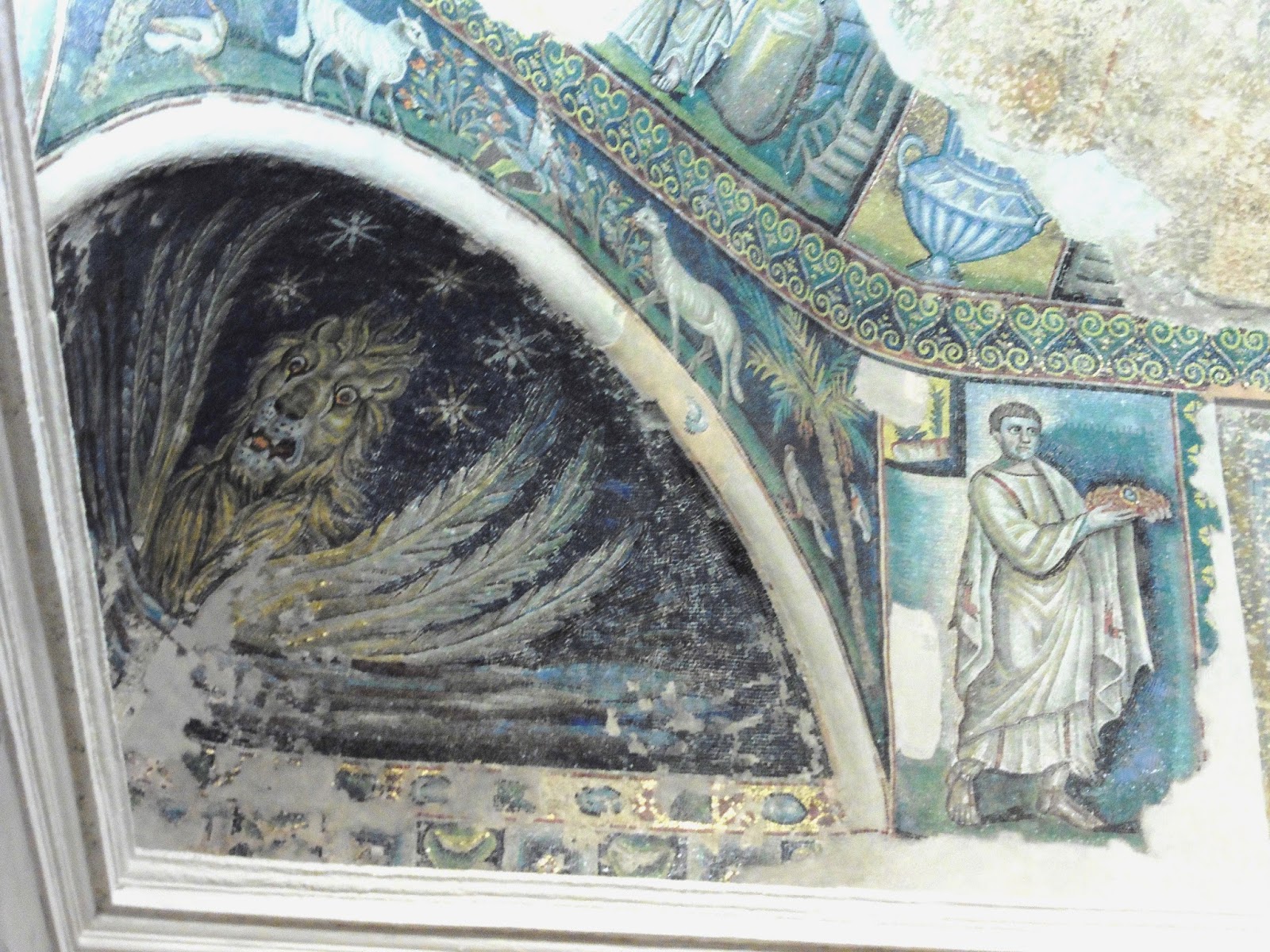
This picture has been doctored a bit, it was quite dim in there.  Each of these corner apses has a symbol of the Evangelists.   Remarkable how architecture and significant groups seem to fit.  Suppose there had been 5 evangelists?  How would that have worked?

I would love to go to Naples again, and see the things I missed, and find better places to eat, or at least have lower expectations this time!


Monday, 12 September 2016

Reading for the Holiday!

I seem to have read about one book for every day we are going to Naples, as a way of preparing myself and returning to  more Italian mindset...

A view of Vesuvias, across Naples


I read Norman Lewis's "Naples 44" which I enjoyed very much at first, until the sheer fuckwittedness of the military miindset and the British and US behaviour in connexion with the Neapolitans, began to depress me.   The description of the Vesusvius eruption was interesting, not one of the more drastic ones, mercifully.   Accounts of how people were starving unaccountably surprised me.  I don't know why.  Obviously they wouldn't have anything to eat.  It must have been a while before food supplies returned (they do during the course of the book).  I wish i knew more, about how people recovered after the war.   I don't suppose those much lauded Elsa Ferrante books tell you that, otherwise they might be worth reading (yes, I know, everyone's reading them, says they are brilliant etc).

Then I began to read "Gomorrah", the journalism on which the film was based.  It was depressing, and would probably make me think it wasn't worth going there, or even frightened to go there.  It's ludicrous, I haven't been to Italy for 8 years, in my 20s I went virtually every year.  I didn't realise I hadn't been to Naples since 1978!  It was a bit of a hustle, but we coped.  I am sure that it is now a bit less ground down and impoverished, and that I am more savvy, so there really shouldn't be a hustle.  And no one has ever tried to steal my handbag from a Vespa.

I bought a book called Joanna, Queen of Naples on the Internet.  It is excellent, but I haven't got very far with it.   The medieval history of Naples is tricky, a lot of discontinuity.  I believe it was part of the Holy Roman Empire for a while (possibly Frederick II hung out there?)  Then there were the Angevins, Charles of Anjou et al (how did they get hold of it?)   Then the Aragonese had it (they couldn't get hold of any more Spain - so they conquered it?  Or was it inherited in some way?).  Eventually it became a Bourbon kingom, the Kingdom of the 2 Sicilies, which is the era I am more familiar with.   Perhaps once I've read the Joannna book I'll be more au fait with the situation.

I also bought a short novel by Alexandre Dumas about Queen Joanna - which I have not yet started.

Then there was Route AD66 - an interesting book about tourism in the Roman Empire.  That was very interesting, but I decided to stop reading it after it left Athens.   The book retraces Tony Peroettet's tour around the favourite Roman tourist itinerary with his girlfriend and intersperses nuggets of information gleaned from classical writers.  A lot of this is familiar stuff, but quite enjoyable, not sure how reliable a lot of it is.   I was a bit mystified by the author, although he presents us with a lot of erudition, he says some remarkable things about the Roman's cotton tunics - the Romans had cotton, imported from India and China, but it was hardly an every day fabric, although I suppose those rich enough to take the Grand Tour could probably afford it.  He also described someone choking on polenta in a Greek inn - unlikely given that maize didn't arrive until the 16th C, there were a couple of other questionable references, which made me think that perhaps he was not exactly steeped in the Classical world, but had simply done a hack job on the source materials.   Still, it was amusing enough.

Tim Parks "Italian Rails" is not strictly about Naples, but it was an excellent way to remind me of the Italian mindset and the important words furbo (cunning) and pignolo (a jobs worth).  It wasn't as funny as some of his other books, but very recognisable.   His conversations on trains, and attempts to avoid them are very true to life.

The first book in this set that I read was Bepe Sevignini's "La Bella Figura" which was a very kindly view of Italians.  It explained them in a better way, and made me understand that perhaps they really were better, more Christian people than, say, Brits.,  It was a good way to read about them, from the inside, rather than the outsider view (however well established Parks is he still knows he's an outsider).

Oh, that's only 7 books, I expect I can count the Lonely Planet Guide, the Eyewitness Guide and other materials, to say nothing of all the websites.

Monday, 5 September 2016

Jeremy Corbyn - in the flesh! And in the garden!


Here is the East Cliff at Ramsgate, the area around the bandstand, opposite Wellington Crescent, where Jeremy Corbyn spoke on Saturday 3rd September.  I had long standing other commitments to cooking that day, but I had to leave the house to take N to A&E and decided to make a detour on the way back to see if I could see anything.  I was thrilled as I dawdled along Wellington Crescent, to see so many people there.  It made me feel rather emotional to think that so many local people had come to hear him.   He was actually speaking as I passed, so I heard a few positive sounding phrases.   I was sorry I hadn't been able to be part of the fun.  I was amused to hear later that UKIP had insisted that there were only 1000 and they had all been bussed in by trade unions.  Even the BBC had said that there were 3,000 people there.  No sign of the coaches could be found.   It contrasts famously with Nasty Nigel's "mass rally" at Cliftonville in 2015.  He spoke from the UKIP battle bus - Jez spoke from the back of a fire engine.   UKIP claimed 300 were present at NN's rally, but a careful count of the audience photo showed approx 79 people.     However, that's enough sectarian nonsense.

Later I was at the BBQ, an LP fundraiser, and someone said "Jeremy Corbyn's here!" and he was, in the kitchen.  So I retreated to the garden, and soon he came out to join us, and we and some others began a chat about gardens and allotments.  I can now reveal the following fab facts.
He has a 30 ft garden which is mostly paved because the soil is largely builders' rubble, however he grows vintes and olive trees, because they thrive on lime.  At his allotment he has grown a lot of beans and spinach which he freezes.  It is difficult to grow some things, because they need daily watering.  He has problems when he goes to the AGM because they always want to vote him onto the Allotment Committee.  Mark told him about our old allotment, and Jane H's niece commented that she goes running up there.  He told us that allotments couldn't be developed by councils if there was demand for them, so clearly we need to create demand to stop local ones disappearing.  Someone said Ramsgate houses had huge gardens, but I said that a lot didn't because they were built as holiday lodgings.  Someone else said that gardens were often full of buildings, and the conversation shifted and Jane H wisely nabbed him to talk to him seriously about mental health...

So, there we have Jeremy Corbyn, a nice beardie man, standing in a summer garden chatting about growing veg.  I didn't even dream of trying to talk politics with him.  Is he ready to lead the country?  Why not?  I swear we've had worse people.   Intellectually/socially he's probably roughly equivalent to David Cameron, able to mix affably with people and have normal conversations, although rather lacking in DC's PR skills.  I also noticed that in conversation he didn't try and draw other people out, this is fairly typical of men in general, so I won't hold it against him too much.    He does have courage and integrity and these are rather more important in a leader.,  I doubt whether Churchill was much of a one to draw out people in conversation either, it's not an essential skill, although I suspect it would help if one was trying to get to know one's Shadow Cabinet better.


The Book Group read #1

I have been in a Book Group for 12 years yet I don't think I have ever blogged about it.  There are about 4 of us who have been in it almost since the beginning (I was not there at the beginning).  We have lost members to bad eyesight, boredom with the books, boredom with one of the other members incessant chat, a refusal to read the books.  Occasionally people have turned up once and never come again, and we had a flounce out of a long-term member.

We have a policy of reading intelligent books that take us out of our comfort zone (actually, I am very seldom taken out of my comfort zone, but I usually enjoy the books).  We have a policy of having no easy books. We occasionally read non-fiction, but most of our choices on the whole are pretty safe and reliable.   If I find them challenging it's sure as dammit the rest of the group will hate them.   There are several former teachers in the group, a retired librarian, retired social worker, a former radiographer and my friend J who worked in the media.  I am the youngest by about 7 years I think. The oldest is 93.  We are all women (the founder and sole male, Barry) moved back to Lewes 11 years ago!

July/August 2016 Book

River of Smoke by Amitahv Ghosh


We read Sea of Poppies in 2010, but no one could remember it, except me, because I absolutely loved it and thought it was brilliant and wished to write something that clever but knew that I couldn't.   Recently the third book in the trilogy came out, and I suddenly realised we hadn't read the second one yet.

It is a long book and it is, like its predecessor written from several points of view.  The main character is an opium smuggler called Barry Mohdi - it is set chiefly in 1830s Canton and the main characters are Parsee, Muslim, English, French, Chinese etc.   Canton was clearly a fantastic place.  The story tells of the events surrounding a clampdown on Opium sales in China and the characters are becalmed in Canton, trying to sell their illicit cargoes.  There is also a search for an illusory form of paeony (or was it azalea?).  So many different strands, and the whole society is brought alive.   Characters such as Neel are carried over from the previous book, but I had forgotten about him until halfway through.

Modhi is a deeply sympathetic character, rather like Robert Maxwell.  The book is curiously relevant, because it echoes the present economic times, with merchants who are illiberally fixated on Free Trade at all costs, regardless of what this will do to the economy.  The British sold the Chinese opium, because they had no other commodities the Chinese wished to buy.  They did not wish to have a one-sided trade where they bought tea and silks and porcelain, and all their money went into China in return for perishable goods.   Just like the Roman Empire, and just like now.  The modern obsession with Free Trade in a globalised market place went echoing through the book.

My favourite aspect of the book were the camp and clever letters written by the young artist Chinnery to his friend "my fair Puggelina".  Ghosht manages to transform her nickname into every imaginable silly camp foreign title and never repeat himself once.  It was a delight, and it lightened the tone of what would have been some very depressing events that could have turned the whole book into a gloom-fest.  Clever!

The other glory of the book was the fact that one was getting "history lite" in the most stimulating possible way.  I understand far more about that period and the run up to the Opium Wars than I ever have before.  A five star read if ever there was one.

Tuesday, 30 August 2016

End of Month Accounts

I feel I am about to start a new term, with an almost clean slate.

Many of the matters that were hanging over me during July and August (apart from the book) have been cleared up.

Harry, while not deliriously happy, is a bit sorted, with a job, an income, regular trips to a probation officer, and will be paying rent from the end of the month. He should be seeing a bereavement counsellor in the future.

Ned is back for a break, sorted with a new house, trying to get a job, and shortly going to re-start working.
So he's sorted, ish - because still depressed and low and anxious about the degree.

Finn has a job, part time, for weeks.  He's also able to go back and do selected bits of his A-levels, which is a good thing.  Much relieved to find this out!  And I didn't have to bribe them with a massive donation to school funds.

And Mark still hasn't finished his first Cambridge report, but our financial problems have been massively relieved by an influx of funds from my Pa.   As a result we are going to Naples for a week or so next month.  I am still in limbo about the book, but I have "peace" about it, because chatting to Tara yesterday, I decided not to self-publish in October.  Somehow this has freed me up mentally to start writing again, or at least working on research for the new book.   A complex multi-stranded story of 3 women who are in conflict with the authorities of their day.  Yay!  Misogyny through the Ages!

Sunday, 14 August 2016

The New Family member

Since late July we have had a new family member, my nephew Harry.  The reasons why he is living with us are dramatic, criminal and sensational (by my standards) and they are not really my story to tell.  However, he came here, or rather I collected him from a homeless hostel in Andover on 20th July (when there was a full Moon in his birth sign, Capricorn, which suggests something has finally crystallised).  Originally my idea was that he would be here for a fortnight and then we'd see what happened.  By 6th August, when my father came over, with Coells, I had been impressed by how sensible and organised (relatively) Harry was, and how he had immediately set to to sign on and look for jobs.

The anger and disgust I feel at my brother's behaviour is appalling.  I was telling a friend about how he'd behaved and the consequences, and she had tears of sympathy for Harry in her eyes.  Dear thing!    The funny thing is, I haven't had a lot to do with H over the years, I don't exactly get on with his mother, and he appeared at Christmas and sometimes in summer and I seldom talked to him.  But I do remember when he was a child thinking what a short straw he and his sister had drawn getting T as a father and saying to myself "well, all I can do, is be there if they need me."  I had forgotten this vow until a week or so after I'd rescued Harry (I know that seems a strong word, but it is what I did).

 There was something very intense about my response, when I heard that he was sleeping rough I immediately thought I ought to get him (I had already thought I would ask him to stay when I heard he was in prison).Anyway, I feel it was a sort of unconscious memory of the historic vow that impelled me to go immediately, and overcome my historic torpor.    I didn't have any real doubts about it, I needed to check with M and F of course, but they were both surprisingly positive about the idea.  I realised that some of my Christian ideas must have rubbed off on them  as thet both felt it was the right thing to do.  There was no resistence, only a slight anxiety about the disposition of the kitchen knives, but nothing more.  When I suggested he stay longer term, everyone including Ned seemed happy about that.   In a weird way, although it means I have even more blokes hanging around, it makes me feel more connected with the rest of my family.  

Tuesday, 26 July 2016

What I have not blogged about 2

Finn's A-levels
N's mental health
A trip to Norwich
Our drinks party and the loveliness of many friends
The Ramsgate Festival
My nephew H
My appalling brother's appallingness
The snails
The weather
What the hell am I going to do with my life if I stop writing?
The Littoral Lumations and why does Littoral have 2 t's when it comes from litus?  
Am I getting stupider and less able to concentrate
My gout???
Dull stuff about dietary habits  (be grateful).
What I have been reading  (not very much).
Finn's job prospects.

Tuesday, 12 July 2016

Labour Party splits...

Another failed FB post on the Thanet & Sandwich LP page....

The truth behind all this is that the party has moved so far to the right since even Jim Callaghan's time, that Corbyn's policies are less radical than the 1983 LibDem manifesto - and there are people in the party who like it that way. I dare say if it was policy to introduce the NHS now, the right of the party would be saying "Oh no, that will upset the insurance companies and the doctors will all leave the UK...." The fact that people are joining who are roughly on the same page politically as Nye Bevan is sending the right of the party into a flat spin - yet there was nothing unelectable about Bevan and Callaghan..I don't think I've met you Edward Lucas, but whenever I read one of your posts I feel quite angry. You've become the Simon Heffer of this page - the power to annoy without the power to actually do very much. I've always believed the LP was a broad church and that was the only way it would gain mass appeal, I don't believe in deselections and expulsions and suspensions except in extreme cases (subjective!)...but how on earth can we work together if people keep putting up destructive and futile posts?